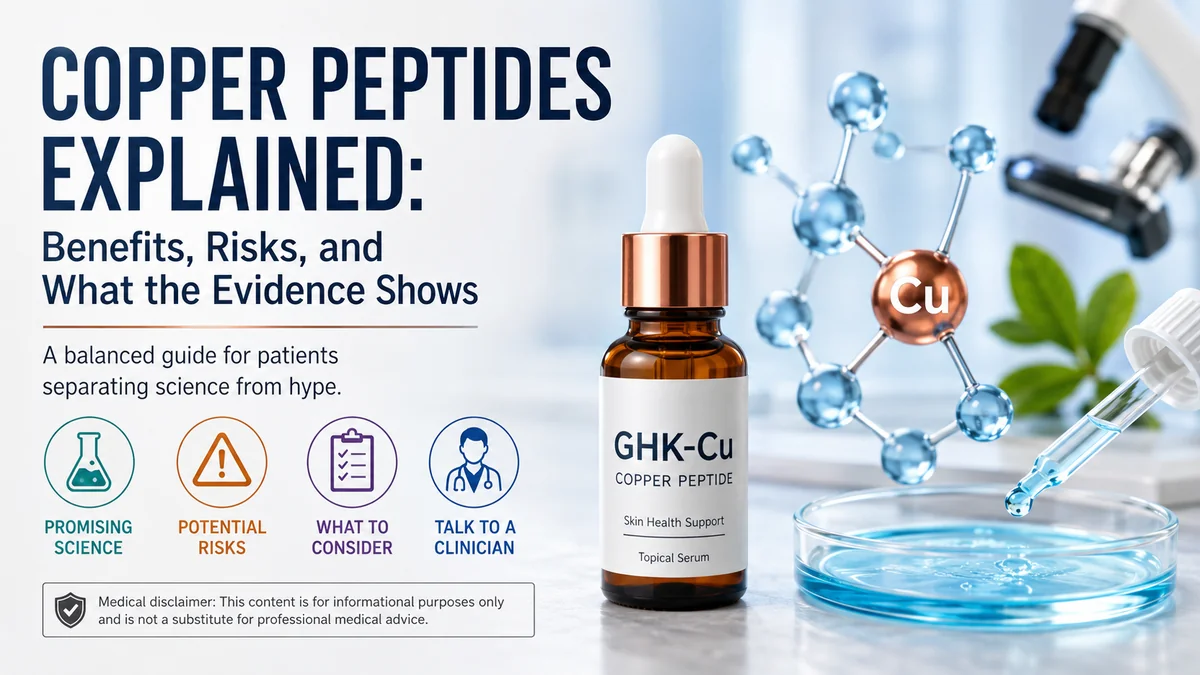
Peptides have moved from research settings into everyday wellness conversations. One of the best known is GHK-Cu, a copper-binding peptide found naturally in human plasma, saliva, and urine. It is promoted in skin care, hair care, and regenerative health spaces, often with claims that run ahead of settled medical evidence.
That creates a familiar healthcare problem: patients must sort useful science from commercial noise. In the wider medication access system, BorderFreeHealth connects U.S. patients with licensed Canadian partner pharmacies and supports cash-pay, cross-border prescription options for eligible patients where jurisdiction allows. The same safety mindset applies when evaluating emerging products: understand what is regulated, what is experimental, and when clinician guidance matters.
Why copper peptides attract medical attention
Copper is an essential trace mineral. The body uses it in enzymes involved in connective tissue, wound repair, antioxidant activity, and normal cell function. Copper peptides are small protein fragments that can bind copper and may help deliver it within biological systems.
Researchers have studied GHK-Cu for possible effects on collagen production, inflammation, wound healing, and skin repair. Much of this work comes from laboratory studies, animal models, or small human studies. These findings are scientifically interesting, but they do not automatically prove broad clinical benefit.
In consumer settings, copper peptides are most often used in topical skin products. People may seek them for fine lines, texture, redness, post-procedure recovery, or hair concerns. In medical terms, however, those uses vary widely in evidence quality. A cosmetic ingredient is not the same as a proven treatment for disease.
Where evidence is promising, and where it is thin
The strongest consumer-facing case for copper peptides is in skin care. Some studies suggest topical use may support skin firmness or appearance in selected settings. These findings are usually modest and depend on the formulation, concentration, skin condition, and study design.
The evidence is much thinner for sweeping claims about anti-aging, rapid tissue regeneration, systemic healing, or major hair regrowth. Before-and-after photos online are especially weak evidence. Lighting, procedures, other products, hair cycles, and natural healing can all change appearance.
Patients often ask whether the compound is “worth the hype.” A cautious answer is that copper peptides may be a plausible skin-care ingredient for some people, but they should not be treated as a cure-all. When marketing promises results across skin, hair, joints, injuries, and aging, skepticism is appropriate.
Safety questions patients should ask before use
Negative effects depend on the route of use. With topical products, possible reactions include burning, stinging, redness, itching, dryness, rash, or worsening irritation. People with sensitive skin, eczema, rosacea, allergies, or a damaged skin barrier may be more likely to react.
Injectable use raises different concerns. Non-prescribed injections can involve infection, contamination, dosing uncertainty, tissue injury, and unknown long-term effects. Products sold online may not meet pharmaceutical quality standards, even when labels look professional.
Copper itself also deserves respect. It is essential in small amounts, but excess copper exposure can be harmful. People with liver disease, kidney disease, copper metabolism disorders such as Wilson disease, or complex medication regimens should be especially cautious. Pregnant or breastfeeding patients should avoid experimental self-use unless a qualified clinician has reviewed the situation.
Any severe rash, swelling, spreading redness, fever, drainage, or worsening wound should be evaluated promptly. A product marketed for repair should never delay proper wound care, infection treatment, or dermatology assessment.
Over-the-counter access does not equal medical approval
Patients also ask whether they can buy copper peptide products over the counter. Topical cosmetic products containing copper peptides are widely sold in many markets. Their availability does not mean they have been proven to treat medical conditions.
In the United States, cosmetics are not reviewed for effectiveness in the same way prescription drugs are. They may improve appearance, but they cannot lawfully be marketed as treatments for diseases unless they meet drug standards. Supplements and research chemicals raise their own concerns, especially when promoted with medical-sounding claims.
Injectable peptide products require extra caution. Online access does not establish that a product is appropriate, sterile, legal for a particular use, or safe for an individual patient. If a therapy is being considered as part of care, the route, source, monitoring plan, and clinical reason should be clear.
A useful rule is simple: the more invasive the route, the higher the safety bar. A leave-on cosmetic serum is not risk-free, but it is very different from injecting a substance into tissue.
How clinicians can help sort claims from care decisions
For many people, the best first step is not asking whether a peptide is trendy. It is defining the health concern. Fine lines, acne scarring, hair shedding, chronic wounds, and surgical recovery are different problems. They require different evaluations.
A dermatologist can assess skin goals and recommend evidence-based options. A primary care clinician can review medical history, medications, pregnancy status, and risk factors. A wound-care specialist should be involved when healing is delayed, infection is possible, or circulation problems are present.
Good healthcare navigation also means asking practical questions. What outcome is expected? How soon would improvement be judged? What are safer alternatives? Who monitors side effects? What signs mean the product should be stopped?
This approach protects patients from two common problems. The first is overestimating benefit from early science. The second is delaying proven care while trying an unproven option. Both can happen even when a product has a real biological basis.
A balanced view for patients
Copper peptides deserve neither dismissal nor blind enthusiasm. The biology is interesting, and topical products may have a reasonable role for some cosmetic goals. But broad claims about regeneration, anti-aging, or injectable transformation need stronger evidence.
Patients should be especially cautious with products that promise dramatic results, encourage self-injection, avoid discussing risks, or present research findings as guaranteed personal outcomes. Independent clinical advice is most important when a product is invasive, expensive in time or effort, or being used for a medical condition.
Medical disclaimer: This content is for informational purposes only and is not a substitute for professional medical advice. Patients should consult a qualified healthcare professional before starting, stopping, or changing any treatment or health product.
The safest path is to match the level of evidence to the level of risk. For copper peptides, that usually means modest expectations, careful attention to product type, and clinician input when the use moves beyond routine skin care.